A server implementing the TypeSafe/Jev HTTP API with Qwen3.6-35B-A3B on SGLang.

Each container one B200 with SGLang 0.5.19's Rust frontend,
radix caching, and breakable prefill CUDA graphs. A separate Python API process
uses FastAPI, uvloop, the Rust-backed HF tokenizer, and pooled asynchronous HTTP
connections to SGLang on localhost. CUDA dependencies stay in SGLang's container;
uv sync on your laptop installs only the API, deployment tools, and tests.
uv sync
# Only if you haven't authenticated Modal on this machine:
uv run modal setup

# Start a temporary Server, run actual inference checks, then shut it down:
uv run modal run modal_app.py

# Deploy a stable public endpoint:
uv run modal deploy modal_app.py
The deployment prints a https://...us-west.modal.direct URL. It uses a
Modal Server, unauthenticated=True,
routing_region="us-west", and compute_region=["us-west", "us-central", "us"].
Autoscaling has no explicit container cap and scales to zero after five idle minutes.
Set min_containers=1 in modal_app.py to keep a B200 warm.
If SGLang exits unexpectedly, the API exits too. The Modal launcher watches the
API and exits the container so Modal can replace it, rather than leaving a live
HTTP process with a dead inference backend. Normal shutdown disarms both watchers.
Cache warmups also request one unused token probability to avoid SGLang's mixed-logprob batch crash. This keeps warmups and scoring requests batch-compatible without patching SGLang.
The first build imports a large SGLang image. The first GPU start also downloads
weights and compiles/captures kernels. Model weights persist in the
openjev-huggingface Modal Volume, alongside SGLang's tuning cache and Triton
compilation cache. Later starts reuse these files; CUDA graph capture still runs
at startup. The Rust frontend receives an explicit local tokenizer directory to
avoid remote-name lookup issues with revision-pinned snapshots.
A scaled-to-zero Server returns 503 while it
starts; the included smoke command retries startup responses.
uv run openjev smoke https://YOUR-SERVER.us-west.modal.directThe smoke test covers all three answer types, a 64-answer question, basic semantic
sanity checks, and rejection of 65 answers. It reports startup wait, inference
latency, and cache usage. modal run saves this report as smoke-result.json.
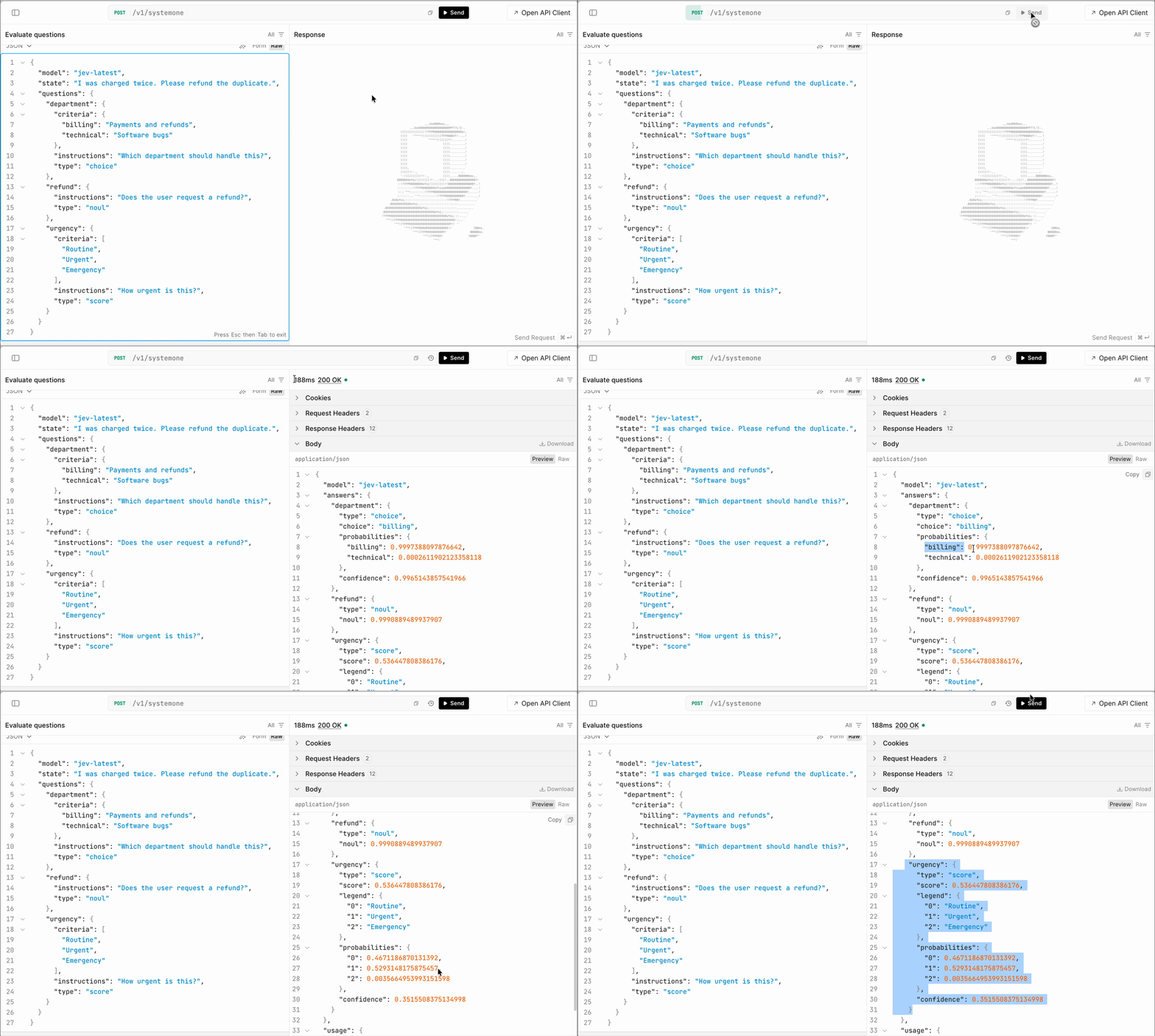
curl "$OPENJEV_URL/v1/systemone" \
  -H 'Content-Type: application/json' \
  -d '{
    "model": "jev-latest",
    "state": [
      {"role": "system", "content": "You are a support assistant."},
      {"role": "user", "content": "I was charged twice. Please refund the duplicate."}
    ],
    "questions": {
      "refund": {
        "type": "noul",
        "instructions": "Does the user request a refund?"
      },
      "department": {
        "type": "choice",
        "instructions": "Which department should handle this?",
        "criteria": {"billing": "Payments and refunds", "technical": "Software bugs"}
      },
      "urgency": {
        "type": "score",
        "instructions": "How urgent is the request?",
        "criteria": ["Routine", "Urgent", "Emergency"]
      }
    }
  }'
Or use curl "$OPENJEV_URL/v1/systemone" -H 'Content-Type: application/json' --data-binary @examples/request.json.
state and instructions accept strings, JSON objects, or arrays. A state that is
a list of chat messages, or exactly {"messages": [...]}, is rendered using the
model's native chat template. Original roles and message objects are retained;
the classification question becomes an additional user turn, even after another
user turn. Other structured state is serialized intact into a user message.
Objects containing messages plus additional fields are kept intact so metadata
isn't silently discarded. Chat state supports text, not image/audio/video content.
| Route | Purpose |
|---|---|
POST /v1/systemone |
Noul, Choice, and Score evaluation |
GET /v1/models |
Model catalogue with TypeSafe and OpenAI-style fields |
GET /v1/limits |
Admission limits |
GET /health |
Readiness, including SGLang health and startup duration |
GET /health/live |
API process liveness |
GET / |
Scalar API reference with an editable example and request client |
GET /docs |
Built-in Swagger UI |
GET /openapi.json |
Generated API schema |
jev-latest is a compatibility alias for the configured Qwen model. The public
model ID is Qwen/Qwen3.6-35B-A3B;
NVIDIA's repository is only the internal weight source. Set
OPENJEV_SERVED_MODEL_NAME or openjev serve --served-model-name NAME to override
the public ID. It is also passed to SGLang as --served-model-name.
No requests go to TypeSafe. The public server is
the evaluation API; SGLang's generation and administration routes remain on
localhost and aren't forwarded publicly.
- Validate the schema, answer count, body size, context length, and total token budget.
- Render the native chat template once, with thinking disabled. Split out a common prefix and independently tokenize each question suffix.
- Send the common prefix to
/generatewithmax_new_tokens=1, await completion, and discard the sampled token. This warms SGLang's radix cache. - Concurrently send
prefix + question suffix + assistant header + "Answer:\n"for each question. Every call again hasmax_new_tokens=1. Requesttoken_ids_logprobfor every answer label andlogprob_start_len=-1, so there is no need to recompute prompt logprobs. The sampled token itself is ignored. - Renormalize the requested label logprobs with stable softmax. Noul returns
P(yes), Choice returns the argmax and full distribution, and Score returnssum(level_index * probability)with zero-based levels and a legend.
Options are rendered as A: description, B: description, etc., without JSON
wrappers. Choice keys identify response fields and are hidden from the model,
except when a description is null: then the option key supplies its meaning,
matching Jev's nullable description schema.
This is a prefill plus first-token-readout workload: there is no generated chain of thought and no autoregressive continuation after the first token. There are N+1 one-token calls for N questions, including the cache-warming call. Speculative decoding is not enabled.
Qwen tokenizes 10 and 64 as multiple tokens. Answer labels are therefore
A–Z, followed by verified single-token letter combinations (AA, AB, ...).
All 64 labels are checked against the actual tokenizer at startup. Your original
option names are preserved in the returned distribution. This keeps 64-way
classification an exact one-token readout instead of comparing only the first
digit of a multi-token number.
Radix reuse is opportunistic, not a pinned per-request KV session. Hybrid Qwen's
recurrent state, cache page boundaries, cache pressure, and concurrent requests
can reduce hits. The backend uses --mamba-radix-cache-strategy extra_buffer.
x-openjev-prefix-tokens exposes the requested common prefix size. When SGLang
reports cache counts, x-openjev-cached-tokens sums the branch cache hits. SGLang
0.5.19's Rust frontend omits these counts: the header is absent and smoke reports
null, rather than a misleading zero. Scheduler logs still show actual cache
hits (verified on the live B200 deployment). Server-Timing separates
prompt preparation, the shared prefill, and branch inference.
usage.input_tokens sums SGLang's full prompt counts across the warm-up and all
branches, including cached tokens. usage.output_tokens is N+1. These are backend
usage counts, not TypeSafe billing estimates or unique tokens actually computed.
Defaults are 64 questions, 2–64 answers per Choice/Score, 2 MiB JSON,
32,768 tokens per branch including its output, 262,144 total submitted input
tokens, 16 simultaneous evaluations, and 64 simultaneous backend calls.
Invalid requests return 422 before inference; oversized bodies return 413;
overload returns 529 with Retry-After. Backend timeouts return 504. Failed or
cancelled evaluations cancel sibling requests and attempt to abort them in SGLang.
All settings can be provided as OPENJEV_* environment variables; see
src/openjev/config.py. Common settings:
| Variable | Default |
|---|---|
OPENJEV_MODEL |
nvidia/Qwen3.6-35B-A3B-NVFP4 |
OPENJEV_SERVED_MODEL_NAME |
Qwen/Qwen3.6-35B-A3B (profile-specific public name) |
OPENJEV_REVISION |
Pinned NVIDIA checkpoint revision for the default model |
OPENJEV_FRONTEND |
rust (python is an explicit fallback) |
OPENJEV_MAX_INPUT_TOKENS |
32768 |
OPENJEV_MAX_TOTAL_INPUT_TOKENS |
262144 |
OPENJEV_MAX_CONCURRENT_REQUESTS |
16 |
OPENJEV_MAX_CONCURRENT_BRANCHES |
64 |
OPENJEV_REQUEST_TIMEOUT |
120 seconds |
OPENJEV_TEMPERATURE |
1.0, applied during label normalization |
OPENJEV_API_KEY |
Unset; optional Bearer authentication for the API |
OPENJEV_BACKEND_API_KEY |
Unset; optional separate SGLang Bearer key |
The Modal launch script forwards OPENJEV_PROFILE, OPENJEV_FRONTEND, and
OPENJEV_SERVED_MODEL_NAME from the local environment. To customize other remote settings,
add them to image.env(...) or
use a Modal Secret for keys. The default Modal endpoint intentionally has no auth.
OpenJev defines
confidence = 1 - H(probabilities) / log(number_of_options), clamped to [0, 1].
This is zero for a uniform distribution and one for a point mass. Probabilities
are conditioned on the supplied options, depend on prompt and label ordering,
and are not calibrated estimates of correctness.
uv sync
uv run pytest                         # offline unit + API tests
uv run pytest -m integration          # real tokenizer, small HF download, no GPU
uv run ruff check .
uv run openjev schema                 # no GPU or model download

# Connect to an existing backend; it must have matching model/tokenizer revision,
# selected-token logprobs, radix cache, and a sufficient context length:
uv run openjev serve --connect http://127.0.0.1:30000

# On a B200 host/container with SGLang 0.5.19 installed in another environment:
uv run openjev serve --sglang-python /path/to/sglang/bin/python