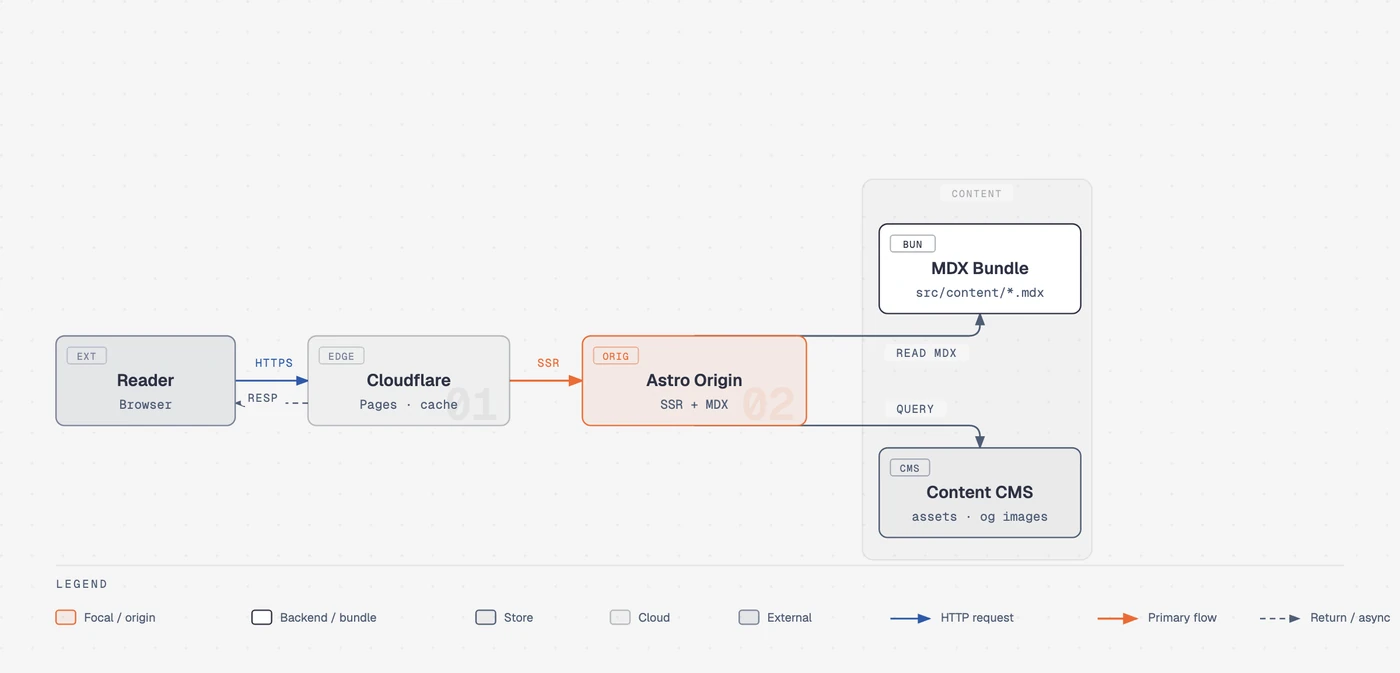
Editorial diagrams your designer won't hate.


New in 2.0 — the Loop: flywheels with a shared-memory hub. The dashed lines are the write-backs.
New in 2.3: semantic system patterns and optional accessible motion, while static output stays the default.
New in 2.5.10: ten more layout grammars — Sankey, fishbone, Wardley map, kanban, user journey, deployment, dependency graph, UML class, story map, and database schema.
39 editorial diagram types for Claude Code, Codex, Factory Droid, Pi, and Agent Skills-compatible hosts. Self-contained HTML + SVG. No shadows. No Mermaid slop. Semantic patterns describe behavior separately from layout, so a queue, policy trace, or trust boundary can use the nearest existing type without expanding the type count. Static HTML remains the default; optional motion is available for ordered explanations. The skill also redraws draw.io or Mermaid sources at a chosen format, size, and detail level.
No Figma. No generic rounded boxes. No 30-minute color-picking sessions.
I write at littlemight.com (and run BestSelf.co on the side). Every time I needed a diagram — an architecture sketch, a flowchart, a pyramid of what matters most — I'd ask Claude and get back a generic rounded-box thing that looked nothing like the rest of the site. I'd either fight with Figma for 30 minutes or just skip the diagram.
So I built a Claude Code skill for it. Thirty-nine visual types, editorial quality, matches your brand in 60 seconds by reading your website.
The highest-quality move is usually deletion. Every node earns its place. The accent color is reserved for the 1–2 things the reader should look at first. Target density: 4/10.
All 39 visual types ship in three static variants: minimal light, minimal dark, and full-editorial. Open any of them directly in a browser. There is no build step, JavaScript, or external image dependency.
Architecture Components + connections |
 IT current-state Legacy landscape + modernization |
 Flowchart Decision logic |
 Sequence Messages over time |
 State machine States + transitions |
 ER / data model Entities + fields |
 Timeline Events on an axis |
 Swimlane Cross-functional flow |
 Quadrant Two-axis positioning |
 Radar / spider Multi-axis comparison |
Loop / flywheel Reinforcing cycle + shared hub |
 Nested Hierarchy by containment |
 Tree Parent → children |
 Org chart Ownership + routing |
 Layer stack Stacked abstractions |
 Venn Set overlap |
 Pyramid / funnel Ranked hierarchy or drop-off |
 Bar chart Categorical comparison |
 Treemap Part-of-whole by area |
 Line chart Trends over time |
 Gantt Tasks + phases on a timeline |
 Scatter plot Distribution + correlation |
 High-Level End-to-end stack on a cluster |
 Process Multi-actor sequential workflow |
 Medallion Multi-tier data storage |
 Data flow Role-scoped pipeline steps |
 DP integration Sources → core → consumers |
 DP security matrix Per-role access permissions |
 Sankey Quantities that split + merge |
 Fishbone Grouped causes → one effect |
 Wardley map Value chain × evolution |
 Kanban Work in progress by state |
 User journey Stages, actions + sentiment |
 Deployment Zones, hosts + artifacts |
 Dependency graph Fan-in, ranks + cycles |
 UML class Classes, operations + typed relations |
 Story map Backbone × release slices |
 Database schema Physical tables + column FKs |
 Polar chart Cyclic magnitude · linear radius |
The v2.5.10 release added the final ten types above. Compare their light, dark, and full-editorial variants in the 30-variant contact sheet.
Browse the live gallery: cathrynlavery.github.io/diagram-design — or open skills/diagram-design/assets/index.html locally to flip through all 39 diagrams with light / dark / full-editorial tabs.
Claude Code:
/plugin marketplace add cathrynlavery/diagram-design
/plugin install diagram-design@diagram-design
Then enable updates once: run /plugin, open Marketplaces, select diagram-design, and choose Enable auto-update. Claude Code disables auto-update by default for third-party marketplaces; after this toggle, it refreshes the marketplace and installed plugin in the background after startup. Run /reload-plugins when prompted, or let the next session load the update.
Codex:
codex plugin marketplace add cathrynlavery/diagram-design
codex plugin add diagram-design@diagram-design
Codex refreshes configured Git marketplaces at startup. To fetch immediately, run codex plugin marketplace upgrade diagram-design and start a new session.
Factory Droid:
droid plugin marketplace add https://github.com/cathrynlavery/diagram-design
droid plugin install diagram-design@diagram-design --scope user
Droid tracks Git plugins by commit rather than the manifest's display version. To fetch a merged update, run droid plugin marketplace update diagram-design, then droid plugin update diagram-design@diagram-design --scope user, and start a new session.
Claude Cowork (organization marketplace): Organization GitHub marketplaces currently require a private or internal repository, so first mirror this public repository into one owned by your organization. In Organization settings → Plugins, choose Add plugin → GitHub, connect that mirror, and enable Sync automatically from the marketplace menu. Automatic sync runs when a pull request containing a plugin version bump is merged to the mirror's default branch; direct pushes do not trigger the webhook. Install Diagram Design from the resulting organization marketplace.
Pi:
pi install https://github.com/cathrynlavery/diagram-designRun /reload in an open Pi session. Pi makes the skill available for matching diagram requests; use /skill:diagram-design to invoke it explicitly. Pi also loads the /export-diagram, /import-mermaid, /profile, and /doctor prompt templates. The unpinned Git install is intentional: Pi has no automatic package refresh, so run pi update --extensions to pull merged updates.
Kiro: Import the Agent Skill from the repository subdirectory URL:
https://github.com/cathrynlavery/diagram-design/tree/main/skills/diagram-design
Kiro copies imported skills into .kiro/skills/ for a workspace or ~/.kiro/skills/ globally, so re-import the URL to pick up updates. Custom agents that declare resources should include skill://diagram-design/**/SKILL.md.
OpenCode: Copy or symlink skills/diagram-design/ to .opencode/skills/diagram-design in a project or ~/.config/opencode/skills/diagram-design globally. OpenCode has no Diagram Design marketplace package; copied installs update only when you replace the directory from a newer checkout.
One-time migration: an existing standalone
npx skills addcopy will not start following the Codex marketplace automatically. Remove that standalone copy, then use the Codex marketplace commands above. Likewise, uninstall a personal Cowork copy and reinstall Diagram Design from your organization's marketplace. Future marketplace version bumps then flow through each client's native update path.
Managed installs are convenient, but changes to references/style-guide.md may be replaced by package updates. Saved profiles in ~/.diagram-design/profiles/ survive updates, and projects with a .diagram-design marker are unaffected. Clone the repo and install the local path if you plan to customize the working style guide directly:
git clone git@github.com:cathrynlavery/diagram-design.git ~/code/diagram-design

# Pi: register the checkout as a local package
pi install ~/code/diagram-design

# Claude Code: symlink the inner skill
ln -s ~/code/diagram-design/skills/diagram-design ~/.claude/skills/diagram-design

# Other Agent Skills hosts: create only the roots you use
mkdir -p ~/.agents/skills ~/.cursor/skills ~/.cline/skills ~/.kiro/skills ~/.config/opencode/skills
ln -s ~/code/diagram-design/skills/diagram-design ~/.agents/skills/diagram-design
ln -s ~/code/diagram-design/skills/diagram-design ~/.cursor/skills/diagram-design
ln -s ~/code/diagram-design/skills/diagram-design ~/.cline/skills/diagram-design
ln -s ~/code/diagram-design/skills/diagram-design ~/.kiro/skills/diagram-design
ln -s ~/code/diagram-design/skills/diagram-design ~/.config/opencode/skills/diagram-design
The shared skill lives at skills/diagram-design/. Pi discovers it through the repo's standard skills/ package directory; Claude Code, Codex, Factory Droid, and other Agent Skills-compatible tools use the same files.
The whole point: ship editorial-quality diagrams in your colors and typography, not a generic template.
Out of the box, diagrams render in a clean jet-black + atomic-tangerine palette (white-smoke paper, jet-black ink, atomic-tangerine accent, blue-slate muted, silver hairlines). Good enough to screenshot straight away. But 60 seconds of onboarding is better — the skill will pull your brand from your website and apply it across every diagram.
You:     "onboard diagram-design to https://yoursite.com"
Agent:   → fetches the homepage
         → extracts the dominant palette + font stack
         → maps detected values to semantic roles:
             paper, ink, muted, accent, link
         → shows a proposed diff
         → writes your tokens to references/style-guide.md
You:     "yes, apply it"
Every new diagram now uses your colors. Your website's paper color becomes the diagram background. Your CTA color becomes the focal accent. Your body font stack becomes the node label family.
Brand matching also emits a fidelity receipt: sampled URLs, exact color roles, font families and weights, font source URLs, and any fallback. Public site fonts are used directly and verified after rendering rather than silently replaced with generic system fonts.
| Detected from your site | Becomes |
|---|---|
<body> background |
paper token |
| Primary text color | ink token |
| Secondary / caption text | muted token |
| Cards or containers | paper-2 token |
| Most-used brand color (CTA, link, heading) | accent token |
<h1> font family |
title font |
<body> font family |
node-name font |
<code> / <pre> font |
sublabel font |
Before writing tokens, the skill verifies WCAG AA contrast on ink over paper. If your site has a color that fails contrast at diagram sizes (9–12px), it proposes an adjusted value and explains why.
Every diagram template gives the inline SVG an accessible name and description: role="img", a resolving aria-labelledby, and first-child <title> / <desc> slots. IDs are prefixed per diagram and variant, so multiple SVG exports can be safely inlined on one page without duplicate accessible-name IDs. Decorative specimen icons are hidden from assistive technology instead.
Prefer to set tokens by hand? Open skills/diagram-design/references/style-guide.md and edit the table. Everything downstream reads from there — all 39 diagrams, the annotation primitive, and the gallery all inherit semantic role names (accent, not #eb6c36).
The skill won't silently ship default-skinned diagrams into a branded project. On first use in a new project, it checks if style-guide.md has been customized. If not, it pauses and asks:
"This is your first diagram in this project. The style guide is still at the default. Want to run onboarding, paste tokens manually, or proceed with default?"
See skills/diagram-design/references/onboarding.md for the full spec.
Onboard a brand once, save the result as a named profile, then add a .diagram-design marker containing profile: <slug> to each client project. Marker projects read ~/.diagram-design/profiles/<slug>.md directly, so parallel workspaces can use different brands without overwriting a shared installed style-guide.md.
The profile library is shared across Claude Code, Codex, Factory Droid, and Pi. Use /diagram-design:profile in Claude Code, /profile in Factory Droid or Pi, or ask in natural language in any host. See profiles.md for the storage, marker, and recovery contract.
# From a cloned checkout, open the gallery to see all 39 diagrams
open skills/diagram-design/assets/index.html       # macOS
xdg-open skills/diagram-design/assets/index.html  # Linux

# In Claude Code, Codex, Factory Droid, or Pi, ask:
# "Make me an architecture diagram of my app: frontend, backend, database, Redis cache."
# "I need a quadrant showing Q2 projects by impact vs effort."
# "Give me a sequence of a bearer call with token refresh on 401."
# (branching refresh uses the ALT combined-fragment grammar in type-sequence.md;
#  see skills/diagram-design/assets/example-sequence-oauth.html — not a full authorize-code handshake)
Operator recipes for editable installs, first diagrams, brand setup, import, export, validation, Windows junctions, and reusable prompts live in docs/cookbook.md.
Your agent will pick the right type, build the HTML, and save it. You can also start from a template directly:
cp skills/diagram-design/assets/template.html my-diagram.html        # minimal light
cp skills/diagram-design/assets/template-full.html my-diagram.html   # editorial with summary cards
cp skills/diagram-design/assets/template-motion.html my-diagram.html # optional accessible motionWhen behavior matters, the skill chooses a semantic pattern first and a visual type second. The seven routed patterns cover fan-in queues and bottlenecks, repeated stage slots, unstructured-input transformation, paired policy traces, secure paved roads, governance catalogs, and compensating security layers. Each pattern defines its triggers, primitives, budget, anti-patterns, static fallback, and nearest visual type in semantic-patterns.md.
Motion is optional and does not create another visual type. animation.md defines none, reveal, step, and loop modes with a complete static first frame, deterministic timing, and controls when interaction is available. Reduced-motion output shows the complete static frame and hides/disables playback controls. Motion HTML uses the exact reviewed controller from template-motion.html; arbitrary or modified inline scripts, remote assets, CSS imports, and executable HTML attributes are rejected. The default is none: ordinary output remains static and script-free. example-policy-trace-animated.html is the self-contained interactive example.
Already have diagrams in draw.io / diagrams.net or Mermaid? Point the skill at the source and it redraws them — same content, this design system, at whatever the destination needs.

A 12-node draw.io file redrawn at balanced detail for a blog post. The source's six pastel fills became one accent; its hand-dragged coordinates became a 4px grid.
/diagram-design:import-drawio platform.drawio
/diagram-design:import-drawio platform.drawio --size=slide-16x9 --detail=simplified --audience=executive
/diagram-design:import-drawio platform.drawio --detail=faithful --format=png --page=all
/diagram-design:import-mermaid README.md --diagram=all
/diagram-design:import-mermaid architecture.mmd --size=slide-16x9 --detail=simplified
Or just ask: "redraw this drawio file for my deck", "make this Mermaid block editorial", or "この Mermaid をスライド用にきれいにして".
Reads the common containers draw.io writes — .drawio, .drawio.xml, .drawio.png (embedded diagram), and .drawio.svg — including compressed payloads that look like base64 garbage in an editor.
For Mermaid, it accepts .mmd, .mermaid, and one or more fenced mermaid blocks in Markdown. It parses text only: no rendering, JavaScript, browser, network, or followed click targets.
The point isn't conversion, it's fitting the output to where it's going. Same source file, three different diagrams:
| Dial | Options | What it changes |
|---|---|---|
| Format | html · svg · png · html+png |
The deliverable. SVG for Figma, PNG for slides, HTML for the web. |
| Size | doc-inline · doc-wide · slide-16x9 · slide-4x3 · social-og · social-square · print-a4-landscape · print-letter-landscape · fit |
The viewBox and the type ramp — a projected slide gets 16px node names, not 12px. |
| Detail | faithful (≤24 nodes, zoned) · balanced (≤12) · simplified (≤7) |
How much of the source survives, via a fixed degrade ladder — decorations, then duplicates, then leaf clusters, then infrastructure. |
| Audience | engineer · mixed · executive |
The wording, not the count. Auth Service / JWT · RS256 · :8443 → Auth Service / token check → Sign-in. |
Every import ends with a fidelity ledger — what got merged, collapsed, or dropped. You know the source; you'd notice anyway.
Detail: balanced · 12 source nodes → 8 drawn
Collapsed: "Token valid?" decision → edge label on Gateway → Auth
Dropped:   1 sticky note ("legacy path, to be retired") — unconnected in source
Kept in full: the request path (Web/Mobile → Gateway → Orders → Postgres)
What never carries over: source or renderer coordinates, source palette, source fonts, draw.io's diagonal connector spaghetti, or Mermaid's automatic layout. What always does: components, relationships, grouping, and direction. See references/import-drawio.md, references/import-mermaid.md, and references/output-spec.md.
Diagrams ship as self-contained HTML, but you can export the diagram itself for Figma, slides, or social cards. Use the slash command for your agent:
Pi:
/export-diagram path/to/diagram.html
/export-diagram path/to/diagram.html --svg-only
/export-diagram path/to/diagram.html --png-only --scale=3
Claude Code:
/diagram-design:export-diagram path/to/diagram.html
/diagram-design:export-diagram path/to/diagram.html --svg-only
/diagram-design:export-diagram path/to/diagram.html --png-only --scale=3
Or just ask in natural language:
"Export this diagram as SVG and PNG."
"Save my-diagram.html as PNG."
- SVG — extracts the
<svg>node and injects Google Fonts so it renders standalone in browsers, Figma, and Illustrator. - PNG — rasterizes the diagram via Playwright at 2× by default. One-time setup:
pip install playwright && playwright install chromium.
Both formats are diagram-only — editorial cards and headers from -full variants aren't included. For a screenshot of the full editorial layout, use your browser's print-to-PDF or full-page screenshot. See skills/diagram-design/references/export.md for the full procedure.
For motion-enabled HTML, export the explicit final state: open ?motion=static, wait for document.fonts.ready, and confirm the motion root has data-frame="static" before capture. Use ?motion=step&step=N only when a named intermediate frame was requested.
Progressive disclosure. SKILL.md routes behavior first when needed, then layout. Semantic, type, and animation references load only when relevant.
diagram-design/
├── .agents/plugins/marketplace.json — Codex marketplace catalog
├── .claude-plugin/                  — Claude marketplace + plugin manifest
├── .codex-plugin/                   — Codex plugin manifest
├── .factory-plugin/                 — Factory Droid marketplace + plugin manifest
├── commands/
│   ├── export-diagram.md            — plugin export command
│   ├── import-drawio.md             — plugin draw.io import command
│   ├── import-mermaid.md            — plugin Mermaid import command
│   ├── profile.md                   — plugin client-profile command
│   └── doctor.md                    — plugin environment diagnostics command
├── prompts/
│   ├── export-diagram.md            — Pi `/export-diagram` prompt template
│   ├── import-mermaid.md            — Pi Mermaid import prompt template
│   ├── profile.md                   — Pi `/profile` prompt template
│   └── doctor.md                    — Pi `/doctor` diagnostics prompt template
├── skills/
│   └── diagram-design/
│       ├── SKILL.md                 — philosophy, selection guide, checklist
│       ├── references/              — loaded only when a type or primitive is chosen
│       │   ├── style-guide.md       — single source of truth for colors + fonts
│       │   ├── semantic-patterns.md — behavior patterns independent of layout
│       │   ├── animation.md         — optional motion + accessibility contract
│       │   ├── onboarding.md        — the URL-to-tokens flow
│       │   ├── profiles.md          — named client profiles + project markers
│       │   ├── import-drawio.md     — draw.io redraw procedure
│       │   ├── import-mermaid.md    — Mermaid redraw procedure
│       │   ├── output-spec.md       — format × size × detail level
│       │   ├── export.md            — SVG / PNG export + sizing
│       │   ├── type-architecture.md
│       │   ├── type-flowchart.md
│       │   ├── type-sequence.md
│       │   ├── type-state.md
│       │   ├── type-er.md
│       │   ├── type-timeline.md
│       │   ├── type-swimlane.md
│       │   ├── type-quadrant.md
│       │   ├── type-nested.md
│       │   ├── type-tree.md
│       │   ├── type-org-chart.md
│       │   ├── type-layers.md
│       │   ├── type-venn.md
│       │   ├── type-pyramid.md
│       │   ├── type-sankey.md
│       │   ├── type-fishbone.md
│       │   ├── type-wardley.md
│       │   ├── type-kanban.md
│       │   ├── type-journey.md
│       │   ├── type-deployment.md
│       │   ├── type-dependency.md
│       │   ├── type-uml-class.md
│       │   ├── type-story-map.md
│       │   ├── type-db-schema.md
│       │   ├── primitive-annotation.md
│       │   ├── primitive-sketchy.md
│       │   └── primitive-terminal.md
│       ├── scripts/
│       │   ├── drawio_extract.py    — draw.io → structured IR
│       │   ├── mermaid_extract.py   — Mermaid → structured IR
│       │   └── self_check.py        — packaged output self-check (runs installed)
│       └── assets/
│           ├── index.html           — live gallery, tabbed
│           ├── template*.html       — scaffolds for new diagrams
│           ├── example-<type>.html  — 3 variants × 39 types
│           ├── example-loop-terminal.html
│           ├── example-quadrant-consultant.html
│           ├── example-import-drawio.html
│           ├── example-import-mermaid.html
│           ├── example-policy-trace-animated.html
│           └── example-sequence-oauth*.html
├── scripts/
│   ├── build-readme-thumbs.py       — regenerates docs/screenshots/thumbs/
│   ├── bump-plugin-version.py       — synchronized Claude/Codex/Factory version bump
│   ├── render-canonical-screenshots.py — deterministic 39-type PNG catalog renderer
│   ├── verify-screenshot-freshness.py — source + screenshot digest gate
│   ├── verify-plugin-package.py     — version + marketplace package gate
│   ├── test-plugin-package.py       — adversarial package-gate tests
│   ├── lint-render.py               — Chromium rendered-layout checker
│   ├── verify-doctor.py             — doctor diagnostics contract gate
│   ├── test-verify-doctor.py        — doctor diagnostics adversarial tests
│   ├── verify-polar.py              — quantitative polar encoding gate
│   ├── test-verify-polar.py         — polar gate adversarial tests
│   ├── verify-sankey.py             — Sankey conservation + geometry gate
│   ├── test-verify-sankey.py        — Sankey gate adversarial tests
│   ├── test-verify-docs-sync.py     — docs/routing-surface gate tests
│   └── fixtures/
│       ├── sample-flowchart.mmd
│       ├── sample-readme-with-mermaid.md
│       └── sample-adversarial.mmd
├── docs/cookbook.md                 — operator recipes for editable installs and common tasks
├── docs/adr/                        — short records of settled design decisions
├── docs/screenshots/                — full-resolution images + source-digest manifest.json
└── docs/screenshots/thumbs/         — generated WebP previews the README renders
This keeps the agent's working context tight: routine diagrams load one type reference; behavior-rich diagrams add the routed semantic reference; animation adds its contract only when selected.
Before submitting a new example, run python3 scripts/lint-skin.py <your-new-example.html>.
The repository-wide check python3 scripts/lint-skin.py --all --baseline covers examples and templates and must stay green.
CI separately verifies semantic routing, animated-example structure, animated skin, every shipped motion asset, and adversarial mutations of the controller contract, reporting later gate outcomes even when an earlier gate fails. Semantic routing must pass python3 scripts/verify-semantic-motion.py --markdown-only; the animated example has a separate --example-only gate. Every shipped motion template/example must also pass python3 scripts/verify-motion.py --shipped.
The linter's a11y category rejects diagram SVGs without a resolving accessible name,
an empty or misplaced title/description, or unsafe bare title / desc IDs. It also pins the exact reviewed motion controller and rejects remote assets, CSS @import, non-fragment CSS url(), and executable attributes such as onclick or srcdoc.
If you touch the draw.io import path, python3 scripts/verify-drawio-import.py must also pass —
it drives the real extractor against scripts/fixtures/sample-architecture.drawio in all four
container formats and checks the references stay in sync.
If you touch the Mermaid import path, python3 scripts/verify-mermaid-import.py must also pass —
it covers all supported grammars, multi-block Markdown, adversarial labels, trust-boundary
behavior, resource caps, named failures, and reference/command wiring.
Label placement is gated geometrically: python3 scripts/verify-geometry.py --all fails CI when a label mask overlaps a node declared later in the document, because the node fill would clip the text at render time. python3 scripts/test-verify-geometry.py keeps that checker honest in both directions.
Treemaps get a second geometric gate, because their whole claim is that area is the encoding: python3 scripts/verify-treemap.py --all fails CI when a cell's share of the drawn area doesn't match the value printed inside it, or when a label overruns the cell it names. It measures area error as a relative figure — an absolute one passes exactly the small cells most likely to be wrong. python3 scripts/test-verify-treemap.py keeps it honest in both directions.
Docs and routing surfaces are themselves gated: python3 scripts/verify-docs-sync.py fails CI if the SKILL.md description loses a type's lexical hook, the gallery can't reach a shipped example, the README tree names a file that doesn't exist, a relative reference link is broken, a scanner-visible support path is not shipped inside the skill package, or any command/prompt surface drifts from its routed reference. python3 scripts/test-verify-docs-sync.py exercises those newer checks adversarially, including the strict-bundler behavior used by Hermes Agent. The skill also ships skills/diagram-design/scripts/self_check.py — a distilled output checker installed agents can run on their own generated diagrams; python3 scripts/test-self-check.py keeps it honest. Settled design decisions (why one pinned controller, why patterns never add types, the autoplay policy, the SKILL.md byte cap, why label placement is verified geometrically, and why client profiles use marker-first resolution) live as short ADRs in docs/adr/ — read them before relitigating one, add one when you settle a new policy.
All pull requests and pushes are automatically validated across Linux, Windows, and macOS runners via GitHub Actions CI (.github/workflows/ci.yml).
lint-skin.py reads the source. lint-render.py renders it — headless Chromium
reports what actually got painted, which catches content cut off by the SVG
viewport, collapsed SVGs, horizontal page overflow, missing local assets and JS
errors. Both run in CI on every pull request.
pip install playwright && playwright install chromium   # same dep as PNG export
python3 scripts/lint-render.py --self-test              # checks the checks
python3 scripts/lint-render.py --all                   # examples and templates
python3 scripts/lint-render.py <your-new-example.html>
python3 scripts/lint-render.py --fonts --all           # measure with the real webfonts
Clipping is measured by paint, not geometry: getBoundingClientRect() on an SVG
child ignores stroke width, markers and filter bleed, and knows nothing about
clip-path or overflow: visible, so it both misses real clipping and invents
clipping that isn't there. Instead each SVG is screenshot as authored and again
with its overflow released, and the two are diffed — ink that appears outside
was being cut off. Releases are staged — the SVG alone, then each clipping
ancestor — so a wrapper release can't mask spill at the SVG's own edge, and an SVG
authored overflow: visible inside a clipping wrapper is still checked.
--self-test asserts all of that on 23 cases, over half of them cases that must
not be flagged, and it also asserts the DOM is byte-identical after measuring.
No golden images, so there is nothing to re-record and no PNGs in the repo.
Network is cut at the browser's resolver, which covers WebSockets and anything
else that bypasses request routing, with request routing as a second layer;
--fonts excludes exactly the two Google Fonts hostnames and allows them only
over HTTPS. Since the oracle is pixels, CI pins Playwright and its Chromium build
rather than installing whatever is newest.
Font metrics differ between the default run and --fonts. With network
blocked — the default, and what CI runs — text is laid out in the fallback faces,
not Instrument Serif and Geist. That is deterministic and machine-independent,
which is what a linter needs, but it is not what your reader sees. Run
--fonts --all locally when you care whether real text fits its box.
At startup, the agent sees only the skill name and description. When a request matches, it loads SKILL.md; semantic, type, and animation references are pulled in only when relevant.
| You ask for… | Agent loads |
|---|---|
| "Make me a flowchart" | SKILL.md + references/type-flowchart.md |
| "Build an architecture diagram" | SKILL.md + references/type-architecture.md |
| "Compare why these two policy requests differ" | SKILL.md + references/semantic-patterns.md + references/type-flowchart.md |
| "Animate that policy trace" | Prior selection + references/animation.md |
| "Onboard this skill to my site" | SKILL.md + references/onboarding.md + references/style-guide.md |
| "Use my saved Acme client profile" | SKILL.md + references/profiles.md + ~/.diagram-design/profiles/acme.md |
| "Add an editorial callout to this diagram" | SKILL.md + references/primitive-annotation.md |
| "Give me a hand-drawn version" | SKILL.md + references/primitive-sketchy.md |
| "Give me a terminal / CLI-window version" | SKILL.md + references/primitive-terminal.md |
| "Redraw this .drawio file for my deck" | SKILL.md + references/import-drawio.md + references/output-spec.md + the chosen type's reference |
| "Redraw this Mermaid block for my deck" | SKILL.md + references/import-mermaid.md + references/output-spec.md + the chosen type's reference |
| Routine static diagram-making (any of the 39 visual types) | Only SKILL.md + that one type's reference |
No matter how many types exist, the agent only reads the one you need. Add a new type tomorrow and nothing else changes.
- A routine request ("make me a flowchart") loads
SKILL.mdplus exactly one type reference — nothing else. - Before drawing, the agent states the chosen type, pattern, size, and planned cuts, then renders.
- The output is one
.htmlfile that opens double-clicked, offline, with no network requests beyond Google Fonts. - Screen readers announce the diagram's title and description;
prefers-reduced-motionshows the complete static frame. python3 skills/diagram-design/scripts/self_check.py <file>printsOKon the generated file.- After brand onboarding, new diagrams use your site's paper, ink, accent, and fonts — with a fidelity receipt naming each.
If any of these fail, that's a bug worth filing.
One accent color, 1–2 focal elements per diagram. Three font families: Instrument Serif (title + italic callouts), Geist sans (node names), Geist Mono (technical sublabels). 1px hairline borders, no shadows, max border-radius 10px. Every coord, width, and gap divisible by 4 — non-negotiable, it's what keeps the diagrams from feeling AI-generated. Mono is for technical content (ports, URLs, field types), not a blanket "dev" aesthetic. Coral-tinted focal nodes draw the eye to the 1–2 things that matter. Full spec in SKILL.md.
- Annotation callout — italic Instrument Serif + dashed Bézier leader, for editorial asides that sit in the margins. See
skills/diagram-design/references/primitive-annotation.md. - Sketchy filter — SVG turbulence + displacement map for a hand-drawn variant. Good for essays, not for technical docs. See
skills/diagram-design/references/primitive-sketchy.md. - Icon set — 55 monochrome IT/cloud icons (laptop, phone, user, server, database, Docker, Kubernetes, AWS, Azure, GitHub, Postgres…) for richer architecture and sequence diagrams. Stroked icons from Tabler Icons (MIT); brand silhouettes from Simple Icons (CC0). Each icon uses
currentColorso it inherits the editorial skin or your onboarded brand. Seeskills/diagram-design/references/primitive-icons.md; browse the gallery. Regenerate withpython scripts/build-icons.py.
- Quick unicode diagrams for tweets or terminal output → wiretext-style skill.
- Lists of anything → a table or bullets.
- Before/after comparisons → a table.
- One-shape "diagrams" — a single box with a label → just write the sentence.
Before drawing, ask: would a reader learn more from this than from a well-written paragraph? If no, don't draw.
Contributions are welcome — new diagram types, import grammar support, examples, docs, and tooling. See CONTRIBUTING.md for the validation gates and workflows, and CODE_OF_CONDUCT.md for community standards.
Made by Cathryn Lavery — founder of BestSelf.co. I write about AI, entrepreneurship, and designing nice-looking things at littlemight.com — blog + newsletter.
If this is useful, star the repo and come say hi on X.